A Guide to Presenting Stuff, sort of
A semi-practical guide to how presenting better helps you learn, covering structure, storytelling, practice, and finding your own style as a speaker.
Now I will preface this by saying I’m by no means an authority on public speaking, or even speaking in general. I can’t claim to be a very wise person, and I don’t think I’m particularly smart either. I like speaking to the point that I sometimes probably should shut up a bit more, but you live and learn.
I’ve never really had any issues or major nerves speaking in front of a crowd like some of my peers, but part of that has to do with the fact that I’m fully aware I’m never the smartest person in the room and I’m very comfortable with presenting stuff regardless.
I quite like presenting, but I also enjoy thinking about things I could turn into a presentation. I’m not even fully sure why, but part of it is that it helps me learn better.
It doesn’t always have to be in front of a big crowd either, it can be for a very small audience, or even one to one. If you can explain a complex topic or a complex solution in a way that is easy to understand, I think it displays a high level of understanding compared to rambling out something half-baked.
The extreme version of that is conference speaking, but this article is not really about that specifically, or at least not only. It is about presenting in general, because you are always presenting in some way.
A minor caveat here - there are already a lot of good articles about writing a good CFP or call for speakers, so I am not going too deep into that part. This is not a masterclass in getting accepted to conferences (my submission vs acceptance rate is quite attrocious).
What I want to talk about instead is why presenting is worth doing, why structure matters, and what makes people actually listen (maybe). Even just thinking about things that might be fun and/or interesting to talk about and putting in some effort into research raises your level of understanding even if you never speak of it to anyone.
Why speaking helps you learn
For me, the main benefit of speaking is that I have to research the topic I am talking about to near death (figuratively of course). I want to make sure I know what the best practice is, and where that best practice might not be good practice at all. Context matters and it’s sometimes easy to get lost in the sauce (as the kids say these days) and not see the trees for the forest (I’m all about butchering sayings these days, I’m aware it’s the other way around).
I also need to practice what I’m going to say, which helps me learn through repetition. When I do a presentation, I practice it from start to finish maybe 20 to 30 times, sometimes even 40. You might think “is this guy slow?”, but it’s actually not really about the technical aspect. It takes a lot of time, and I could probably get through it after practicing it once or twice because I usually know what I am talking about.
The point of practicing is not just to remember the material, it is to improve the timing, make sure every point comes across clearly, keep a red thread through the whole thing, and find the places where I am vague, where I jump too quickly, or where I assume too much.
I also find parts where I could possibly fit some time in for a question, crack a joke or get some audience participation. A presentation isn’t just reading PowerPoint bulletpoints until the heat death of the universe, it’s very performative in nature and akin to telling a story, but we’ll get back to that a bit later.
Now, when you are presenting something technical, you have to think hard and long about the audience. If they are already deep in the topic, you can get away with moving faster without doing a lot of groundwork. Even then, I still think you need to lay some foundation to make sure everyone is on roughly the same page.
One experience I had at a small security event really drove this point home for me, where someone jumped straight into a very complex topic. Now the slides were good, obviously knowledgeable speaker, clearly knew the subject. I still did not understand what we were actually talking about until near the end, so I could not follow it properly.
That might be a skill issue on my part, most likely it is, but even with this relatively anecdotal evidence I think the point is valuable to learn: even a knowledgeable audience sometimes needs anchoring and foundation.
That is one of the big benefits of speaking in my eyes - you are forced to distill the content, and you are forced to understand it well enough to explain it in different ways depending on who is listening. That is hard, but it also makes you understand the topic better yourself.
Another benefit is that speaking forces you to think around the topic, not just through it. Maybe you can anticipate what questions the audience will have, or where the weak spots are?
You notice where your explanation depends on context that other people do not have. Context matters a lot, so I usually explain my background and context briefly, noting that some of the things I say might sound insane if they apply their current context.
A example of this in IT could be someone working in a cloud-only environment versus someone working with servers in an on-premise environment. Some security and governance controls are similar, but a lot of things will differ wildly. There’s also probably a reason why something lives on the ground versus in the sky, words like “sovereign” pop up in my mind, and that alters the context.
Knowing how to underline the context you bring helps people understand, and helps people see the bigger picture to be able to apply what you are saying to their own context in a reasonable way.
I think it is useful to reflect through what people might ask, and to be comfortable saying, “I don’t know,” when you genuinely don’t know. That is completely fine in my book.
You are always presenting
I think one of the mistakes people make is treating presenting as something that only happens on a stage. It doesn’t, you present all the time. If you are trying to explain an architecture decision, you are presenting. If you are walking someone through an incident, you are presenting. If you are trying to convince your company to invest in a different approach, you are presenting. If you are explaining a technical problem to one other person, you are presenting.
Presenting is not something that only happens on a stage. You do it all the time.
A very important point a lot of people forget here is that structure matters, even outside more formal presentations and conferences. If you ramble, look at your notes every ten seconds, forget the point you were about to make, or jump back and forth because you realized too late that you forgot something important, the presentation gets worse even if the content is good. Of course, some settings are more or less informal in your own teams and good environments will allow for leeway here.
Content matters a lot, obviously, but the best content in the world can still lose people if the presentation around it is chaotic. If people cannot follow what you are saying, they cannot focus on the substance, and that sounds obvious when you write it out like that, but I still think a lot of people underestimate it.
Presenting is storytelling in that sense, not in a fake or theatrical way, mainly just in the very practical sense that people need a thread to follow.
Getting picked to speak
This is the part I am least qualified to lecture on. Trust me, my hit % for submissions versus acceptance is a statistic that is best kept secret, for my own reputations sake. Just kidding, I don’t really care that much. I think being accepted to speak is a great honor, and if you don’t get accepted then that’s life.
I sometimes see speakers complaining, wondering if “I should go to that conference now that they declined me” and “their talks are not focused on the real issue anymore” and I think that’s not a good take.
As a speaker you spend a lot of time researching, creating presentations and practicing. At my “level” you don’t get paid to do it, and it’s my free time that goes into it - quite a lot of it, actually.
I can understand the frustration when you don’t get selected, but that’s just part of the game. Be happy when you are selected, celebrate others that get selected. Cry in the shower (this will be somewhat of a common theme) if you want.
Again, my success rate was not amazing before I became an MVP, and it did not suddenly become amazing after I became an MVP either. If anything, it got worse (mostly me submitting more proposals). So I am not going to pretend I have some secret formula. Weeeeeell, not unless the formula is “submit stuff, get declined a lot, try again anyway.”
What I do think matters is that you have a clear idea, that the topic fits the conference or track, and that you have thought about how you want people to understand it. Not just what the topic is, but how you want to present it.
If the conference allows it, I think it helps to show that you have considered the structure. What is the hook? What is the explanation at the start? Are there demos? How are you going to make the concepts understandable? That is often where you can show that you have given the talk real thought.
And for the love of all things holy (and unholy?), do not hand the whole thing to AI and let it flatten your thinking for you. Spend time on it yourself. Reflect on what you actually want people to take away. Most conferences are tired of the same words and AI-isms popping up in every call for speaker, so be creative and write it yourself.
There is a practical point here too: not every good idea needs to become a talk. Some ideas are better as blog posts because speaking and writing are different mediums, and if a topic works better written than spoken, that is not a failure, just picking the right format. It can also be that you prefer not to speak and the written medium suits you better.
That’s also fine.
Build the story before the slides
One of the earliest pieces of advice I got was that you never make the slides first. Always lay out the story first, then build slides for it. That advice has held up very well for me, to the point where I consider it mandatory for my own process. What I usually do is write down the topics I want to cover and then talk through them out loud.
The first draft is almost never the finished version. Things move around (a lot, it’s chaos). What felt like the right order in my head turns out not to be the right order when I say it out loud. A small advice here when writing or speaking, always read stuff out loud.
Still, there are a few things I try to keep consistent. First, I want a hook, then I want an explanation of why the topic matters. After that, I want to lay a foundation so people understand what we are talking about, and only then do I want to go deeper.
I also try to spend as little time as possible on talking about myself. I have seen presenters spend ten minutes listing what they have done in the industry before they get to the actual topic. That loses me immediately. I am not there for your biography unless you are Troy Hunt or Mark Russinovich. To be a bit direct, I am there for the thing you came to teach or discuss, not you personally (most of the time, that is).
The foundation part matters because of curse of knowledge. Now, I’m not a knowledgable man in any shape or form, but I know a few things in some niche technical topics. It quickly becomes hard to tell which piece of knowledge is common, and what is specialized knowledge that I hold. I can briefly summarize curse of knowledge as:
Once you know something well, you stop noticing which parts are trivial and which ones are actually common knowledge.
I tend to talk about things I consider fairly niche. The problem is that I do not experience them as niche anymore, because I work with them a lot. So I have to remind myself that my experience is not a shared one, my acronyms that I know like an old friend just confuses most people.
Even at a security conference, not everyone knows the same acronyms, the same tooling, or the same assumptions. Again, context matters and so giving a foundation, anchoring the presentation and providing slight context helps a lot.
Sometimes a simple diagram is enough. Show how the parts fit together. Show what system talks to what. Show where the problem lives. Give people something to orient themselves around before you ask them to follow you into the weeds.

This is roughly the order I am trying to build in my own head before I open PowerPoint:
%%{init: {
    'theme': 'base',
    'themeVariables': {
        'background': '#f3ecde',
        'primaryColor': '#fffaf0',
        'primaryTextColor': '#223248',
        'primaryBorderColor': '#d4c6a8',
        'lineColor': '#1b9b74',
        'fontFamily': 'Georgia, Times New Roman, serif'
    },
    'flowchart': {
        'htmlLabels': false,
        'curve': 'linear',
        'nodeSpacing': 28,
        'rankSpacing': 30,
        'padding': 16
    }
}}%%
flowchart TD
    A["Hook"] --> B["Why it matters"]
    B --> C["Lay the foundation"]
    C --> D["Go deeper"]
    D --> E["Close clearly"]
        classDef stage fill:#fffaf0,stroke:#d4c6a8,color:#223248,font-size:15px,font-family:Georgia,Times New Roman,serif;
        class A,B,C,D,E stage;
        linkStyle default stroke:#1b9b74,stroke-width:1.3px;
The hook can also be combined with why the presentations matter, they share the same purpose - get people interested, get people to care.
After that, you can go in a lot of directions. Personally I like diagrams to explain, I like gifs as punchlines for some humor, and I like logical flowcharts to map out the inside of my mind’s understanding of how things work. I am not great at demos yet, although I want to get better at them.
Most of my time goes into the story itself and making sure the content has a solid foundation in reality. For conferences that rates talks and posts them publically, I will sometimes watch the most popular ones and take notes of things they do that I enjoy and could copy myself.
If I had to boil the process down, it would be this:
- Create a hook
- Start with laying a foundation
- Know what you are trying to teach
- Summarize your points clearly at the end
After that we can start building the slideset, demos and practicing.
Slidework matters more than people think
I think people in general have too few slides. Some have to many. Again, this is preference for the speaker, but for the audience it can matter a lot. This is just my observation, but what happens is that people stay on one slide for too long while talking about things that the slide no longer supports, and at that point the slide starts competing with the speaker instead of helping.
I find that having pictures for the slides where I will spend some time helps instead of say, a bullet list that no longer has any relevance to what you are saying.
Another thing I dread is what I just mentioned, slides filled with bullet points. If your slide is bullet point after bullet point after bullet point, and then you read those bullet points almost word for word, I am gone, mentally, spiritually, academically, all of it.
I will be on my phone, browsing reddit using Firefox (if you know, you know). Anyway, it’s not really engaging to have a person standing with their back towards the audience, reading of slides like it’s primary school reading time again.
Slides do not have to be flashy, but they should help people follow along and support what you are saying. The slides should never, unless it’s a quote, be what you say word for word. Put some effort into good slides, please and thank you.
Substance, flair, and your own style
In IT conference speaking, there is always some minimum level of substance required to get in the door. Some talks have more of it than others. That does not necessarily mean the speaker is smarter or more important, it just means the talk goes deeper. There will always be different levels of talks, from introductionary all the way to “in the trenches technical”. No one type of talk is superior to the other, in my head. It all needs to be said by someone, might as well be me.
Personally, my talks are rarely the deepest or most groundbreaking. I do not think I will ever publish major research or discover something revolutionary, but then again I don’t aspire to do that and I don’t consider that my role. What I tend to do instead is talk about things that I think are misunderstood, neglected, or not talked about enough.
Usually something in the area I work, which means security monitoring, detection engineering, log ingestion strategy, and things around that space. In essence, since I talk about things that others could also theoretically talk about, someone else will often get chosen to do that. So what makes people pick me, aside from the fact that I bribe them handsomely? That’s a joke, for legal and non-legal reasons.
That is where I think the balance between substance and flair comes in. One piece of advice I was given by fellow Microsoft MVP and all-around nice guy and brainiac Marius Sandbu was about the importance of bringing your own style to a presentation, and I think that’s just as important as having a good core topic. You can copy other people’s surface-level habits if you want, but eventually you need to sound like yourself.
For me, that means humor, gifs, and a presentation style that is sometimes a bit lighter than the topic itself. That also means some of my talks are probably more basic than what the most knowledgable experts in the room would want. C’est la vie, shoganai.
For example, I can give a talk about bad detection engineering practices without claiming to be the greatest detection engineer on the planet. I have still seen enough environments to know that many teams need that conversation. So the value is not necessarily that I am bringing the world’s newest or best idea. The value is that I am making a useful point clearly enough that more people might act on it.
That is a perfectly valid kind of talk, I think. I hope so, at least. If it’s not, we can always cry in the shower. It’s a valid coping mechanism, I swear.
Storytelling, imposter syndrome, and stealing like an artist
This isn’t book club, but two books that helped me think more clearly about speaking are Storyworthy by Matthew Dicks and Steal Like an Artist by Austin Kleon. I recommend both, especially to those who believe all speakers are attention-seeking idiots.
Storyworthy helped me think about structure. If you stand there and read bullets points as a list or a matter of fact sequence like “and then this happened, and then this happened, and then this happened,” it gets boring very quickly, and almost anything can be made more engaging if you are conscious about how you tell it.
That does not mean every talk needs twists, dramatic reveals, or some kind of cheesy Marvel plot, it just means people listen better when there is shape to what you are saying. Repetition can help, surprise can help, a good callback can help, humor can help, but most of all a clear thread helps.
Steal Like an Artist helped me with something else: the fact that nearly everyone feels like an imposter at some point. It also has some good general advice - I’m particulary fond of 6, 8 and 9 on the list below.
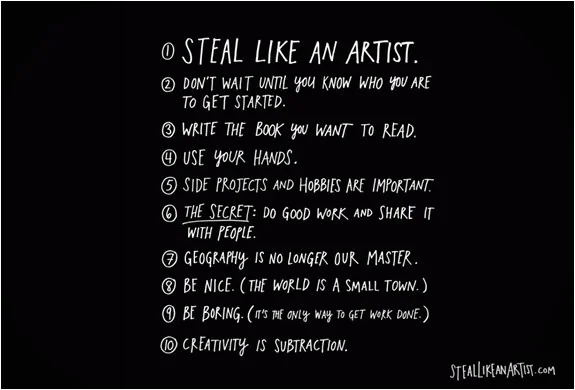
Every time I submit a presentation, I go through what I can only describe as presenter grief. At some point I start thinking, “Why did I submit this? I am an idiot, why would anyone listen to me?” T
hat feeling does not mean you should never present anything ever, it just means you are aware that there are other people who know more than you do. And there will be, there always will be. You probably need to be able to be fine with that. There are also probably people who’ve never given the fact that other people might be more knowledgeable any thought and to that I can only say I both pity and envy you in non-equal amounts.
Not everyone who knows a lot wants to speak. Not everyone who speaks has to be the number one expert in the room. Sometimes people will leave your talk and have learned nothing new. That’s OK. Sometimes a conference will score your talk badly, also fine, although you are allowed to curl up and cry in the shower afterwards. That is part of the deal too and we do love our totally super healthy coping-mechanisms around this part of town.
Once you put something out into the world, you no longer control how people receive it. You can do everything in your power to make it good, but people will still experience it through their own context and their own level of knowledge. That is again just a part of the deal. I don’t usually invoke too much philosophy in my writing, but the Stoic Dichotomy of Control helps me think about this in a healthy way:
- Everything is either something we control, or don’t control.
- We control our emotions, behaviour, and reactions to situations.
- We don’t control anything else, like other people’s behaviours or what they think of us.
- If we wish to be happy/better people, we should focus on the things in our control, namely our behaviour and our reactions to situations.
So while we can certainly strongly influence the way people receieve what we say, we can’t control it. Nor can we control having a good presentation, as it relies on many circumstances that are not up to us. As long as we strive to do our best, that should be enough to be content with our effort.
Another useful thing from Steal Like an Artist is the reminder that when you see another presenter do something smart, you are allowed to learn from it (steal it, in essence). You are allowed to borrow techniques. You are allowed to think, “That worked well. I want to try something like that.” when you see something clever.
Obviously you should not copy people line for line or try to emulate someone directly. But you can absolutely notice what works, try it, keep what feels natural, and discard what does not. Everyone builds on what they have seen before, you just have to be conscious about it.
Final point: practice
If I had to give one piece of advice about speaking, it would be this: practice more than you think you need to. And obviously always have a shower ready to cry in.
Practice without notes. Practice your cadence. Practice where you want to pause, how you want to explain the hardest parts, where people might ask questions, and where they might laugh. Sometimes they will laugh at a point where you said nothing funny, and then you spend the rest of the night in the shower crying again. Anyway. Practice until the structure feels natural enough that you are not fighting it while you are trying to speak.
The point of all this is not to become some conference machine that spams the same session twenty times a year, the point is to get better at understanding what you know, saying it clearly, and helping other people follow along.
If you want to speak at conferences, great. If you just want to become better at explaining technical ideas to other people, also great, the same principles apply.
Stick to topics that genuinely interest you. Find your own style. Steal good ideas from other speakers and make them your own. And remember that presenting is not really about performing expertise. It is about making understanding possible.
GL HF!